Search Thermo Fisher Scientific
Disclaimer

Clicking the images or links will redirect you to a website hosted by BenchSci that provides third-party scientific content. Neither the content nor the BenchSci technology and processes for selection have been evaluated by us; we are providing them as-is and without warranty of any kind, including for use or application of the Thermo Fisher Scientific products presented.
Invitrogen
CD215 (IL-15Ra) Monoclonal Antibody (DNT15Ra), PE, eBioscience™

FIGURE: 1 / 2
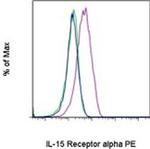
CD215 (IL-15Ra) Antibody (12-7149-80) in Flow
Staining of unstimulated (green histogram) or LPS-stimulated (purple histogram) C57Bl/6 bone marrow derived dendritic cells with 0.06 µg of Anti-Mouse CD215 (IL-15 Receptor alpha). Staining of LPS-stimulated dendritic cells with 0.06 µg of Rat IgG1 kappa Isotype Control PE (Product # 12-4301-82) is shown by the blue histogram. Total viable cells were used for analysis.



Product Details
12-7149-80
Applications
Tested Dilution
Publications
Product Specifications
Species Reactivity
Mouse
Published species
Mouse
Host/Isotype
Rat
/ IgG1, kappa
Recommended Isotype Control
Class
Monoclonal
Type
Antibody
Clone
DNT15Ra
Conjugate
PE
Excitation/Emission Max
565/576 nm
View spectra

Form
Liquid
Concentration
0.2 mg/mL
Purification
Affinity chromatography
Storage buffer
PBS, pH 7.2
Contains
0.09% sodium azide
Storage conditions
4° C, store in dark, DO NOT FREEZE!
Shipping conditions
Wet ice
RRID
AB_10804884
Product Specific Information
Description: This DNT15Ra antibody reacts with the alpha subunit of the Mouse IL-15 Receptor. The IL-15 Receptor alpha subunit is unique to IL-15, while the other two subunits of the receptor, beta and gamma, are shared with IL-2. IL-15R signaling is mediated by Jak/STAT pathways, and results in the activation of neutrophils, dendritic cells, and macrophages. IL-15 has also been found to play a critical role in the development and survival of NK cells and CD8+ T cells.
Although high levels of mouse IL-15 mRNA have been observed in many cell types, free IL-15 is rarely detectable in biological samples. Recent research suggests that IL-15 is retained inside the cell and only secreted in complex with IL-15 Receptor alpha. This chaperoning is necessary from the ER to the Golgi, through secretion. The cytokine/receptor complex may stay bound to the cell surface, where it can be trans-presented to cells expressing the beta-gamma subunits of the receptor, or can be secreted in a soluble form lacking the transmembrane domain of IL-15 Receptor alpha. IL-15 and IL-15 Receptor alpha are expressed by dendritic cells and macrophages in response to inflammatory stimuli.
Our testing suggests that there may be strain differences in expression and staining of the Mouse IL-15 Receptor alpha. This DNT15Ra antibody has been tested on cells from C57Bl/6 mice. Staining has also been observed with this antibody after pre-incubation of NK cells with exogenous Mouse IL-15/IL-15R Complex, suggesting that DNT15Ra will recognize both Mouse IL-15 Receptor alpha and the Mouse IL-15/IL-15R Complex.
Applications Reported: This DNT15Ra antibody has been reported for use in flow cytometric analysis.
Applications Tested: This DNT15Ra antibody has been tested by flow cytometric analysis of mouse dendriric cells. This can be used at less than or equal to 0.125 µg per test. A test is defined as the amount (µg) of antibody that will stain a cell sample in a final volume of 100 µL. Cell number should be determined empirically but can range from 10^5 to 10^8 cells/test. It is recommended that the antibody be carefully titrated for optimal performance in the assay of interest.
Excitation: 488-561 nm; Emission: 578 nm; Laser: Blue Laser, Green Laser, Yellow-Green Laser.
Filtration: 0.2 µm post-manufacturing filtered.
Target Information
Interleukin 15 (IL-15RA) is a cytokine receptor that specifically binds IL-15 with high affinity. IL-15 regulates T and natural killer cell activation and proliferation. The IL-15 and IL-2 receptors share two subunits, IL-2R beta and IL-2R gamma, and IL-15RA is structurally related to IL-2RA, an additional IL-2-specific alpha subunit necessary for high affinity IL-2 binding. Unlike IL-2RA, IL-15RA is capable of binding IL-15 with high affinity independent of the other subunits. IL-15RA is thought to enhance cell proliferation and expression of apoptosis inhibitor Bcl-xL and Bcl-2.
For Research Use Only. Not for use in diagnostic procedures. Not for resale without express authorization.
Flow Cytometry
Panel Builder
How to use the Panel Builder
Watch the video to learn how to use the Invitrogen Flow Cytometry Panel Builder to build your next flow cytometry panel in 5 easy steps.
Bioinformatics
Protein Aliases: CD215; IL 15 receptor; IL 15 receptor subunit α; IL 15R; IL 15R alpha; IL 15R α; IL-15 receptor subunit alpha; IL-15R-alpha; IL15 receptor; IL15 receptor subunit alpha; IL15 receptor subunit α; IL15R; IL15R alpha; IL15R α; Interleukin 15 receptor; Interleukin 15 receptor subunit α; Interleukin-15 receptor subunit alpha; sIL 15R; sIL-15 receptor subunit alpha; sIL-15R-alpha; sIL-15RA; sIL15R; soluble IL 15R; soluble IL15R; Soluble interleukin-15 receptor subunit alpha
Gene Aliases: AA690181; IL-15RA; Il15ra
UniProt ID: (Mouse) Q60819
Entrez Gene ID: (Mouse) 16169
Molecular Function:
 transmembrane signal receptor

Performance Guarantee
If an Invitrogen™ antibody doesn't perform as described on our website or datasheet,we'll replace the product at no cost to you, or provide you with a credit for a future purchase.*
Learn more
We're here to help
Get expert recommendations for common problems or connect directly with an on staff expert for technical assistance related to applications, equipment and general product use.
Contact tech support