Search Thermo Fisher Scientific
Disclaimer

Clicking the images or links will redirect you to a website hosted by BenchSci that provides third-party scientific content. Neither the content nor the BenchSci technology and processes for selection have been evaluated by us; we are providing them as-is and without warranty of any kind, including for use or application of the Thermo Fisher Scientific products presented.
Invitrogen
CD273 (B7-DC) Monoclonal Antibody (122), FITC, eBioscience™
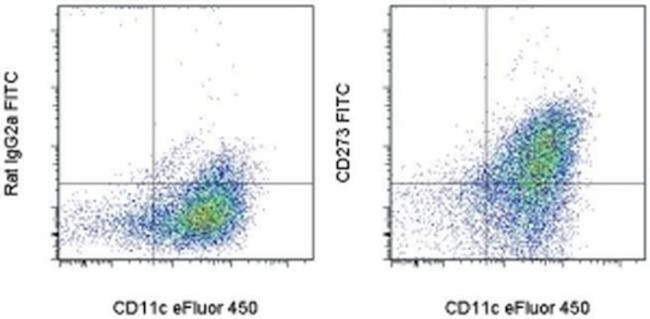
FIGURE: 1 / 3
CD273 (B7-DC) Antibody (11-9972-81) in Flow
Staining of C57Bl/6 bone marrow derived dendritic cells with Anti-Mouse CD11c eFluor® 450 (Product # 48-0114-82) and 0.25 µg of Rat IgG2a K Isotype Control FITC (Product # 11-4321-42) (left) or 0.25 µg of Anti-Mouse CD273 (B7-DC) FITC (right). Cells in the large scatter population were used for analysis.



Product Details
11-9972-81
Applications
Tested Dilution
Publications
Product Specifications
Species Reactivity
Mouse
Published species
Mouse
Host/Isotype
Rat
/ IgG2a, kappa
Recommended Isotype Control
Class
Monoclonal
Type
Antibody
Clone
122
Conjugate
FITC
Excitation/Emission Max
498/517 nm
View spectra

Form
Liquid
Concentration
0.5 mg/mL
Purification
Affinity chromatography
Storage buffer
PBS, pH 7.2
Contains
0.09% sodium azide
Storage conditions
4° C, store in dark, DO NOT FREEZE!
Shipping conditions
Wet ice
RRID
AB_465461
Product Specific Information
Description: The 122 monoclonal antibody reacts with mouse B7-DC, also known as PD-L2. B7-DC, a member of the B7 family, has a predicted molecular weight of approximately 25 kDa and belongs to the Ig superfamily. The mouse B7-DC has a short cytoplasmic tail (4aa). B7-DC is primarily expressed by subpopulations of dendritic cells and monocytes/macrophages in the mouse. Although B7-DC has structural and sequence similarities to the B7 family, it does not bind CD28/CTLA-4, rather it is a ligand for PD-1. The interactions between PD-1 and B7-DC/PD-L2 have been reported to be involved in costimulation or suppression of T cell proliferation depending on state of cellular activation. 122 has been demonstrated to block binding of TY25 (Cat. No.14-5986), another mAb specific for mouse B7-DC.
Applications Reported: This 122 antibody has been reported for use in flow cytometric analysis.
Applications Tested: This 122 antibody has been tested by flow cytometric analysis of mouse bone marrow derived dendritic cells. This can be used at less than or equal to 0.5 µg per test. A test is defined as the amount (µg) of antibody that will stain a cell sample in a final volume of 100 µL. Cell number should be determined empirically but can range from 10^5 to 10^8 cells/test. It is recommended that the antibody be carefully titrated for optimal performance in the assay of interest.
Excitation: 488 nm; Emission: 520 nm; Laser: Blue Laser.
Filtration: 0.2 µm post-manufacturing filtered.
Target Information
Programmed death-ligand 2 (PD-L2), or B7-DC, is a member of the B7 ligand family within the immunoglobulin superfamily that, along with programmed death-ligand 1 (PD-L1), acts as a ligand for programmed cell death protein 1 (PD-1). Though expressed primarily in dendritic cells, PD-L2 expression can be induced on a wide variety of immune and non-immune cells depending on the microenvironment. PD-L2 expression is particularly upregulated in the presence of Th2 cytokine, IL-4, as well as Th1 cytokines, TNF-alpha and IFN-gamma to a lesser degree. While generally expressed at lower levels compared to PD-L1, PD-L2 demonstrates a 2 to 6 times higher relative affinity to PD-1 than PD-L1. PD-1 and its ligands are referred to as inhibitory immune checkpoint molecules in that they provide useful negative feedback during physiological homeostasis. Ligation of PD-L2 or PD-L1 inhibits activation, proliferation, and cytokine secretion (e.g. IFN-gamma, IL-10) in T cells, ultimately dampening immune response. Conversely, studies have shown that PD-L2 can also stimulate T cell proliferation and cytokine production, even in PD-1-deficient T cells, suggesting additional receptors. Recent studies have concluded that PD-L2 also binds to a second receptor, repulsive guidance molecule b (RGMb), which was originally identified as a receptor for bone morphogenetic proteins (BMPs). RGMb is expressed in the central nervous system, as well as in macrophages, however, its role in immunity is only beginning to emerge. Interaction between PD-L2 and RGMb regulates the development of respiratory tolerance in the lung through BMP and/or neogenin signaling pathways. The naturally occurring human PD-L2 monomer consists of a 201-amino-acid extracellular domain, a 21-amino-acid transmembrane domain, and a 32-amino-acid cytoplasmic domain.
For Research Use Only. Not for use in diagnostic procedures. Not for resale without express authorization.
Flow Cytometry
Panel Builder
How to use the Panel Builder
Watch the video to learn how to use the Invitrogen Flow Cytometry Panel Builder to build your next flow cytometry panel in 5 easy steps.
Bioinformatics
Protein Aliases: B7-DC; Butyrophilin B7-DC; butyrophilin-like protein; CD273; MGC124039; MGC124040; PD-1 ligand 2; PD1 ligand 2; PDCD1 ligand 2; Programmed cell death 1 ligand 2; programmed death ligand 2
Gene Aliases: B7-DC; B7dc; Btdc; Cd273; F730015O22Rik; PD-L2; Pdcd1lg2; Pdl2
UniProt ID: (Mouse) Q9WUL5
Entrez Gene ID: (Mouse) 58205
Molecular Function:
 immunoglobulin receptor superfamily

Performance Guarantee
If an Invitrogen™ antibody doesn't perform as described on our website or datasheet,we'll replace the product at no cost to you, or provide you with a credit for a future purchase.*
Learn more
We're here to help
Get expert recommendations for common problems or connect directly with an on staff expert for technical assistance related to applications, equipment and general product use.
Contact tech support