Search Thermo Fisher Scientific
Disclaimer

Clicking the images or links will redirect you to a website hosted by BenchSci that provides third-party scientific content. Neither the content nor the BenchSci technology and processes for selection have been evaluated by us; we are providing them as-is and without warranty of any kind, including for use or application of the Thermo Fisher Scientific products presented.
Invitrogen
CD207 (Langerin) Monoclonal Antibody (eBioRMUL.2), Alexa Fluor™ 488, eBioscience™









Product Details
53-2073-80
Applications
Tested Dilution
Publications
Product Specifications
Species Reactivity
Mouse
Published species
Mouse
Host/Isotype
Rat
/ IgG2a, kappa
Recommended Isotype Control
Class
Monoclonal
Type
Antibody
Clone
eBioRMUL.2
Conjugate
Alexa Fluor™ 488
Excitation/Emission Max
499/520 nm
View spectra

Form
Liquid
Concentration
0.5 mg/mL
Purification
Affinity chromatography
Storage buffer
PBS, pH 7.2
Contains
0.09% sodium azide
Storage conditions
4° C, store in dark, DO NOT FREEZE!
Shipping conditions
Wet ice
RRID
AB_494071
Product Specific Information
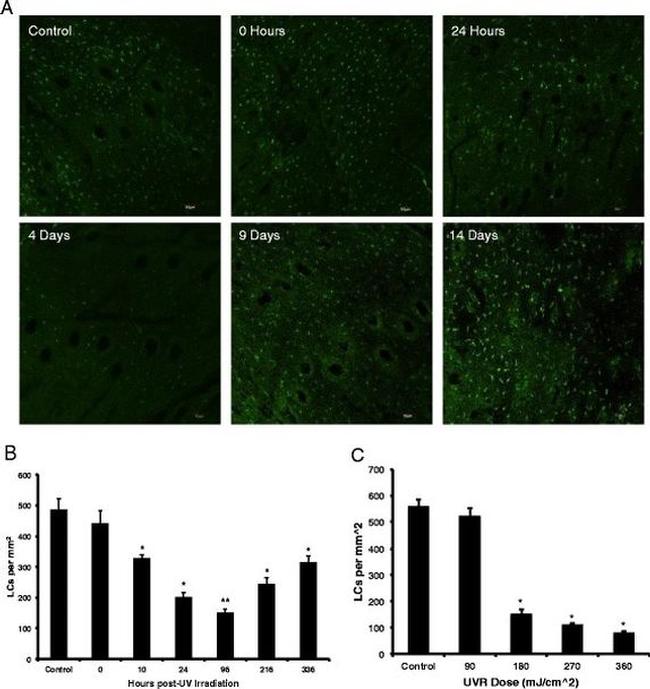
Description: eBioRMUL.2 is a monoclonal antibody that reacts with the predicted extracellular domain of mouse CD207, also known as Langerin. Mouse CD207 is expressed in a distinct subset of dendritic cells called Langerhans cells (LC). Mouse CD207 is a 48 kDa, C-type lectin and putative transmembrane protein that likely plays a role in antigen recognition and uptake. LC are located in the epidermis and upon activation reduce expression of CD207 and begin migrating through the dermis towards lymphatic vessels. Expression of mouse CD207 in LC has been correlated to the presence of Birbeck Granules. Furthermore, the formation of Birbeck Granules has been observed upon transfection of CD207 cDNA into fibroblast cell lines.
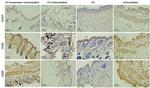
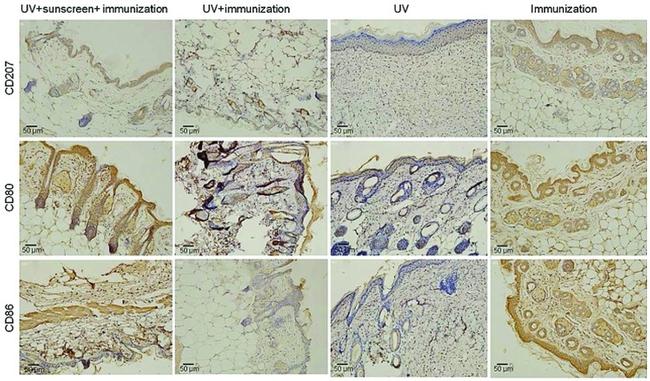
Western Blotting with RMUL.2 reveals a 48 kDa band in lysate from mouse ear epidermis as well as in lysates from cells transfected with mouse CD207 cDNA. Cross reactivity of this antibody with other proteins has not been determined. Preliminary data from mouse CD207 cDNA transfected cells suggests that RMUL.2 can be used for intracellular staining followed by flow cytometric analysis. We have observed in our transfectants the majority of protein is expressed intracellularly with a small percentage on the cell surface. In addition, RMUL.2 has also been tested by immunohistology on mouse ear epidermal sheets and shows specific staining.
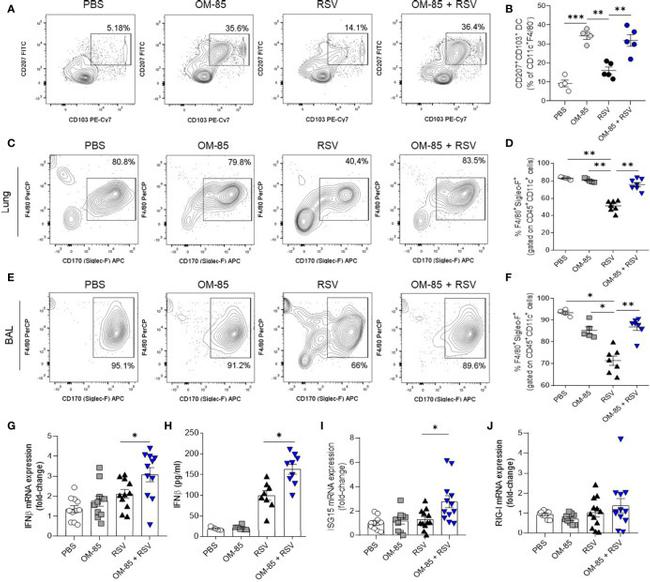
Applications Reported: This eBioRMUL.2 antibody has been reported for use in intracellular staining followed by flow cytometric analysis.
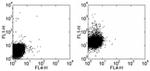
Applications Tested: This eBioRMUL.2 antibody has been tested by intracellular staining and flow cytometric analysis of mouse CD207-transfected HEK-293T cells. Please see Best Protocols Section (Staining intracellular Antigens for Flow Cytometry) for staining protocol (refer to Protocol B: One-step protocol for intracellular (nuclear) proteins). This can be used at less than or equal to 1 µg per test. A test is defined as the amount (µg) of antibody that will stain a cell sample in a final volume of 100 µL. Cell number should be determined empirically but can range from 10^5 to 10^8 cells/test. It is recommended that the antibody be carefully titrated for optimal performance in the assay of interest.
Excitation: 488 nm; Emission: 519 nm; Laser: Blue Laser.
Filtration: 0.2 µm post-manufacturing filtered.
Target Information
Langerin (CD207) is a type II membrane-associated C-type lectin known to be expressed exclusively by Langerhans cells. Lamgerin recognizes mannose residues via its single carbohydrate recognition domain (CRD). Langerin is localized not only on the cell surface, but also intracellularly in close association with Birbeck granules. Transfection of Langerin cDNA into fibroblasts creates a compact network of membrane structures with typical features of Birbeck granules (BG). Langerin is thus a potent inducer of membrane superimposition and zippering leading to BG formation.
For Research Use Only. Not for use in diagnostic procedures. Not for resale without express authorization.
Bioinformatics
Protein Aliases: C-type lectin domain family 4 member K; CD207; Langerhans cell specific c-type lectin; Langerin
Gene Aliases: Cd207; Clec4k
UniProt ID: (Mouse) Q8VBX4
Entrez Gene ID: (Mouse) 246278
Molecular Function:
 membrane traffic protein

Performance Guarantee
If an Invitrogen™ antibody doesn't perform as described on our website or datasheet,we'll replace the product at no cost to you, or provide you with a credit for a future purchase.*
Learn more
We're here to help
Get expert recommendations for common problems or connect directly with an on staff expert for technical assistance related to applications, equipment and general product use.
Contact tech support