Search Thermo Fisher Scientific
Disclaimer

Clicking the images or links will redirect you to a website hosted by BenchSci that provides third-party scientific content. Neither the content nor the BenchSci technology and processes for selection have been evaluated by us; we are providing them as-is and without warranty of any kind, including for use or application of the Thermo Fisher Scientific products presented.
Invitrogen
RUNX1 Monoclonal Antibody (RXDMC), PE, eBioscience™

FIGURE: 1 / 3
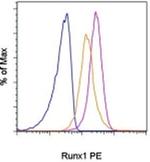
RUNX1 Antibody (12-9816-80) in Flow
C57Bl/6 thymocytes were stained with Anti-Mouse CD4 APC (Product # 17-0041-82) and Anti-Mouse CD8a FITC (Product # 11-0081-82), followed by intracellular staining with 0.5 µg of Rat IgG2a K Isotype Control PE (Product # 12-4321-80) (blue histogram) or 0.5 µg of Anti-Human/Mouse Runx1 PE using the Foxp3 Staining Buffer Set and protocol (Product # 00-5523-00). The histogram demonstrates Runx1 staining of CD4 SP (purple histogram) and CD8 SP (orange histogram) thymocytes.


Product Details
12-9816-80
Applications
Tested Dilution
Publications
Product Specifications
Species Reactivity
Human,
Mouse
Published species
Mouse
Host/Isotype
Rat
/ IgG2a, kappa
Recommended Isotype Control
Class
Monoclonal
Type
Antibody
Clone
RXDMC
Conjugate
PE
Excitation/Emission Max
565/576 nm
View spectra

Form
Liquid
Concentration
0.2 mg/mL
Purification
Affinity chromatography
Storage buffer
PBS, pH 7.2
Contains
0.09% sodium azide
Storage conditions
4° C, store in dark, DO NOT FREEZE!
Shipping conditions
Wet ice
RRID
AB_11151519
Product Specific Information
Description: This RXDMC monoclonal antibody reacts with human and mouse Runx1, which is also known as AML1. This 50-kDa transcription factor is expressed in hematopoietic cells such as myeloid, T, and B cells, but not erythroid cells. Furthermore, Runx1 can be detected in nearly all non-hematopoietic tissues except the brain and heart. Runx1 is involved in several stages of T cell development, including the CD4-CD8- double negative (DN) to CD4+CD8+ double positive (DP) transition and commitment to the CD4 lineage. In addition to its role in thymocyte development, Runx1 has also been implicated in Th2 differentiation and immune homeostasis via direct interaction with Foxp3 in CD4+CD25+ regulatory T cells. Runx1 also affects Th2 differentiation by negatively regulating Gata-3 expression. Finally, the AML1 gene, which encodes Runx1, is a frequent target of translocations in acute myeloid leukemia.
In humans, alternative splicing results in the generation of eleven isoforms. In mice, five isoforms exist as a result of alternative splicing; isoform 4 (aka AML1-C) is the most highly expressed in hematopoietic cells. Sequence analysis indicates that the RXDMC antibody recognizes isoform 4 in mouse and all human isoforms except AML-1FA, AML-1FB, and AML-1FC.
Applications Reported: This RXDMC antibody has been reported for use in intracellular staining followed by flow cytometric analysis.
Applications Tested: This RXDMC antibody has been tested by intracellular staining and flow cytometric analysis of mouse thymocytes using the Foxp3/Transcription Factor Staining Buffer Set (cat. 00-5523) and protocol. This can be used at less than or equal to 1 µg per test. A test is defined as the amount (µg) of antibody that will stain a cell sample in a final volume of 100 µL. Cell number should be determined empirically but can range from 10^5 to 10^8 cells/test. It is recommended that the antibody be carefully titrated for optimal performance in the assay of interest.
Excitation: 488-561 nm; Emission: 578 nm; Laser: Blue Laser, Green Laser, Yellow-Green Laser.
Filtration: 0.2 µm post-manufacturing filtered.
Target Information
RUNX1 belongs to the mammalian RUNX family of DNA binding proteins that regulate the expression of genes involved in cellular differentiation and cell cycle progression. RUNX1 is essential for hematopoietic stem cell generation in the vascular regions of the aorta, vitelline and umbilical arteries, yolk sac and placenta. RUNX1 is expressed in all tissues except brain and heart, with highest levels in thymus, bone marrow and peripheral blood.
For Research Use Only. Not for use in diagnostic procedures. Not for resale without express authorization.
Flow Cytometry
Panel Builder
How to use the Panel Builder
Watch the video to learn how to use the Invitrogen Flow Cytometry Panel Builder to build your next flow cytometry panel in 5 easy steps.
Bioinformatics
Protein Aliases: Acute myeloid leukemia 1 protein; AML-1; aml1 oncogene; AML1-EVI-1 fusion protein; CBF-alpha 2; CBF-alpha-2; core binding factor alpha 2; Core-binding factor subunit alpha-2; core-binding factor, runt domain, alpha subunit 2; Oncogene AML-1; OTTHUMP00000108697; OTTHUMP00000108700; OTTHUMP00000108702; PEA2-alpha B; PEBP2-alpha B; Polyomavirus enhancer-binding protein 2 alpha B subunit; RUN1; runt domain, alpha subunit 2; Runt-related transcription factor 1; RUNX1/ZNF687 fusion; SL3-3 enhancer factor 1 alpha B subunit; SL3/AKV core-binding factor alpha B subunit; transcription factor
Gene Aliases: AML1; AML1-EVI-1; AMLCR1; CBF-alpha-2; CBF2alpha; CBFA2; EVI-1; Pebp2a2; PEBP2aB; PEBP2alpha; Pebpa2b; RUNX1
UniProt ID: (Human) Q01196
Entrez Gene ID: (Human) 861, (Mouse) 12394
Molecular Function:
 DNA-binding transcription factor
immunoglobulin fold transcription factor
Runt transcription factor
gene-specific transcriptional regulator
DNA-binding transcription factor
immunoglobulin fold transcription factor
Runt transcription factor
gene-specific transcriptional regulator
ossification
chondrocyte differentiation
transcription from RNA polymerase II promoter
hemopoiesis
positive regulation of granulocyte differentiation
positive regulation of interleukin-2 production
positive regulation of angiogenesis
positive regulation of transcription, DNA-templated
positive regulation of transcription from RNA polymerase II promoter
peripheral nervous system neuron development
hematopoietic stem cell proliferation
skeletal system development
in utero embryonic development
liver development
myeloid progenitor cell differentiation
regulation of T cell anergy
transcription, DNA-templated
regulation of transcription, DNA-templated
regulation of transcription from RNA polymerase II promoter
central nervous system development
negative regulation of cell proliferation
regulation of signal transduction
myeloid cell differentiation
neuron differentiation
negative regulation of granulocyte differentiation
hair follicle morphogenesis
response to retinoic acid
positive regulation of interferon-gamma production
embryonic hemopoiesis
negative regulation of transcription, DNA-templated
behavioral response to pain
neuron development
definitive hemopoiesis
regulation of hair follicle cell proliferation
cellular response to transforming growth factor beta stimulus
positive regulation of cell maturation
positive regulation of progesterone secretion
regulatory region DNA binding
RNA polymerase II regulatory region sequence-specific DNA binding
core promoter binding
transcriptional activator activity, RNA polymerase II transcription regulatory region sequence-specific binding
protein binding
ATP binding
RNA polymerase II transcription factor activity, sequence-specific DNA binding
DNA binding
transcription factor activity, sequence-specific DNA binding
calcium ion binding
transcription factor binding
protein homodimerization activity
protein heterodimerization activity
repressing transcription factor binding

Performance Guarantee
If an Invitrogen™ antibody doesn't perform as described on our website or datasheet,we'll replace the product at no cost to you, or provide you with a credit for a future purchase.*
Learn more
We're here to help
Get expert recommendations for common problems or connect directly with an on staff expert for technical assistance related to applications, equipment and general product use.
Contact tech support