Search Thermo Fisher Scientific
Invitrogen
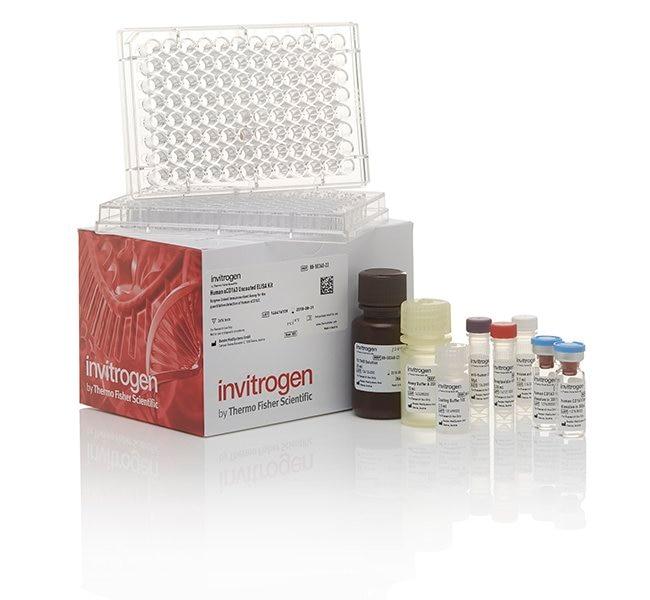
IL-17AF (heterodimer) Human Uncoated ELISA Kit with Plates
Product Specifications
Analytical sensitivity
30 pg/mL
Assay range
30-4,000 pg/mL
Sample type/volume
Plasma
100 µL
Serum
100 µL
Supernatant
100 µL
Hands-on time
1 hr 45 min
Time-to-result
24 hr 30 min
Homogenous (no wash)
No
Instrument
Colorimetric Microplate Reader
Product size
2 x 96 Tests
Contents
Capture Antibody: Pre-titrated, purified antibody
Detection Antibody: Pre-titrated, biotin-conjugated antibody
Standard: Recombinant cytokine for generating standard curve and calibrating samples
Assay Diluent: 5X concentrated
Wash Buffer: 10X concentrated (100 mL of 10X per plate)
Detection enzyme: Pre-titrated Avidin-HRP
Substrate Solution: Tetramethylbenzidine (TMB) Substrate Solution
Stop Solution: 5 mLs of 1X solution per plate
Certificate of Analysis: Lot-specific instructions for dilution of antibodies and standards
Detection Antibody: Pre-titrated, biotin-conjugated antibody
Standard: Recombinant cytokine for generating standard curve and calibrating samples
Assay Diluent: 5X concentrated
Wash Buffer: 10X concentrated (100 mL of 10X per plate)
Detection enzyme: Pre-titrated Avidin-HRP
Substrate Solution: Tetramethylbenzidine (TMB) Substrate Solution
Stop Solution: 5 mLs of 1X solution per plate
Certificate of Analysis: Lot-specific instructions for dilution of antibodies and standards
Shipping conditions
Wet ice
Storage
2-8°C
Protein name
IL-17AF
Species (tested)
Human
Assay kit format
Uncoated ELISA Kit with Plates
Detector antibody conjugate
Biotin
Label or dye
HRP
About This Kit
The Human IL-17AF (heterodimer) Uncoated ELISA Kit contains pre-matched antibody pairs, plates and reagents for performing quantitative enzyme linked immunosorbent assays (ELISA) to detect and quantify protein levels of human IL-17AF. Wash Buffer and Stop Solution are needed to complete the ELISA reaction and are sold separately.
Principle of the method
ELISAs are designed to measure the amount of the target bound between a matched antibody pair. A target-specific antibody is coated to the bottom of the wells of a microplate, which is an overnight process. Samples, standards, or controls are then added into these wells and bind to the immobilized (capture) antibody. A sandwich is formed by the addition of the second (detector) antibody, a substrate solution is added that reacts with the enzyme-antibody-target complex to produce measurable signal. The intensity of this signal is directly proportional to the concentration of target present in the original specimen.
Target information
IL-17A and IL-17F are well-characterized homodimeric cytokines secreted by T helper 17 (Th17) cells, gamma-delta T cells and several subsets of innate lymphoid cells. Somewhat less appreciated, IL-17A and IL-17F subunits can also form the heterodimer, IL-17AF. Together, these three dimers signal through the IL-17RA/IL-17RC receptor complex to mediate immune responses at mucosal interfaces and are found at lesion sites in inflammatory bowel disease, asthma, atopic dermatitis and rheumatoid arthritis.
For Research Use Only. Not for use in diagnostic procedures. Not for resale without express authorization.
Bioinformatics
Gene aliases : CANDF6, CTLA-8, CTLA8, IL-17, IL-17A, IL-17F, IL17, IL17A, IL17F, ML-1, ML1
Gene ID : (Human) 3605, (Human) 112744
Gene symbol : IL17A, IL17F
Protein Aliases : CTLA-8, Cytokine ML-1, Cytotoxic T-lymphocyte-associated antigen 8, cytotoxic T-lymphocyte-associated protein 8, IL-17, IL-17A, IL-17F, interleukin 17 (cytotoxic T-lymphocyte-associated serine esterase 8), Interleukin-17A, Interleukin-17F
UniProt ID (Human) Q16552, (Human) Q96PD4

Performance Guarantee
If an Invitrogen™ antibody doesn't perform as described on our website or datasheet,we'll replace the product at no cost to you, or provide you with a credit for a future purchase.*
Learn more
We're here to help
Get expert recommendations for common problems or connect directly with an on staff expert for technical assistance related to applications, equipment and general product use.
Contact tech support