Search Thermo Fisher Scientific
Disclaimer

Clicking the images or links will redirect you to a website hosted by BenchSci that provides third-party scientific content. Neither the content nor the BenchSci technology and processes for selection have been evaluated by us; we are providing them as-is and without warranty of any kind, including for use or application of the Thermo Fisher Scientific products presented.
Invitrogen
CCL2 (MCP-1) Monoclonal Antibody (5D3-F7), APC, eBioscience™

FIGURE: 1 / 1
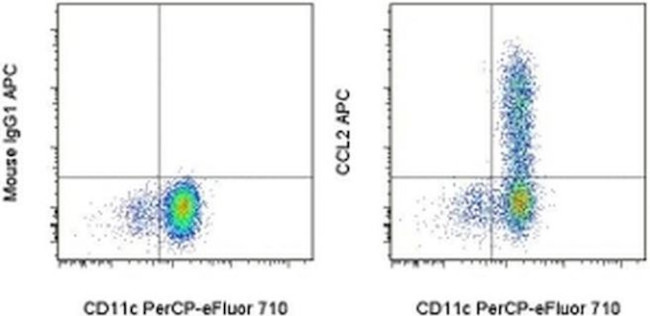
CCL2 (MCP-1) Antibody (17-7099-81) in Flow
Normal human peripheral blood cells were stimulated with LPS for 5 hours in the presence of Monensin Solution (Product # 00-4505-51). The cells were intracellularly stained with Anti-Human CD11c PerCP-eFluor® 710 (Product # 46-0116-42) and 0.03 µg of Mouse IgG1 K Isotype Control APC (Product # 17-4714-81) (left) or 0.03 µg of Anti-Human CCL2 (MCP-1) APC (right) using the Intracellular Fixation & Permeabilization Buffer Set (Product # 88-8824-00) and protocol. Cells in the monocyte gate were used for analysis.

Product Details
17-7099-81
Applications
Tested Dilution
Publications
Product Specifications
Species Reactivity
Human
Published species
Human
Host/Isotype
Mouse
/ IgG1, kappa
Recommended Isotype Control
Class
Monoclonal
Type
Antibody
Clone
5D3-F7
Conjugate
APC
Excitation/Emission Max
651/660 nm
View spectra

Form
Liquid
Concentration
0.2 mg/mL
Purification
Affinity chromatography
Storage buffer
PBS, pH 7.2
Contains
0.09% sodium azide
Storage conditions
4° C, store in dark, DO NOT FREEZE!
Shipping conditions
Wet ice
RRID
AB_469500
Product Specific Information
Description: The 5D3-F7 antibody reacts with human, cynomolgus, and rhesus monkey monocyte chemoattractant protein-1 (MCP-1), also known as monocyte chemotactic and activating factor (MCAF) and CCL2. MCP-1 is a CC chemokine which presents as a dimer. Derived from monocytes and vascular endothelial cells, it exerts chemoattractant activity on a variety of cell types, such as monocytes, basophils, T cells and NK cells via chemokine receptors such as CCR2, CCR5, and CCR10.
Applications Reported: This 5D3-F7 antibody has been reported for use in intracellular staining followed by flow cytometric analysis.
Applications Tested: This 5D3-F7 antibody has been tested by intracellular staining and flow cytometric analysis of stimulated normal human peripheral blood cells using the Intracellular Fixation & Permeabilization Buffer Set (cat. 88-8824) and protocol. Please refer to Best Protocols: Protocol A: Two step protocol for (cytoplasmic) intracellular proteins located under the Resources Tab online. This can be used at less than or equal to 0.06 µg per test. A test is defined as the amount (µg) of antibody that will stain a cell sample in a final volume of 100 µL. Cell number should be determined empirically but can range from 10^5 to 10^8 cells/test. It is recommended that the antibody be carefully titrated for optimal performance in the assay of interest.
Excitation: 633-647 nm; Emission: 660 nm; Laser: Red Laser.
Filtration: 0.2 µm post-manufacturing filtered.
Target Information
This gene is one of several cytokine genes clustered on the q-arm of chromosome 17. Cytokines are a family of secreted proteins involved in immunoregulatory and inflammatory processes. The protein encoded by this gene is structurally related to the CXC subfamily of cytokines. Members of this subfamily are characterized by two cysteines separated by a single amino acid. This cytokine displays chemotactic activity for monocytes and basophils but not for neutrophils or eosinophils. It has been implicated in the pathogenesis of diseases characterized by monocytic infiltrates, like psoriasis, rheumatoid arthritis and atherosclerosis. It binds to chemokine receptors CCR2 and CCR4.
For Research Use Only. Not for use in diagnostic procedures. Not for resale without express authorization.
Flow Cytometry
Panel Builder
How to use the Panel Builder
Watch the video to learn how to use the Invitrogen Flow Cytometry Panel Builder to build your next flow cytometry panel in 5 easy steps.
Bioinformatics
Protein Aliases: C-C motif chemokine 2; chemokine (C-C motif) ligand 2; H-MCP-1; HC11; MCAF; MCP-1; MGC9434; Monocyte chemoattractant protein 1; monocyte chemoattractant protein-1; Monocyte chemotactic and activating factor; Monocyte chemotactic protein 1; Monocyte secretory protein JE; RP23-350G1.3; small inducible cytokine A2 (monocyte chemotactic protein 1, homologous to mouse Sig-je); small inducible cytokine subfamily A (Cys-Cys), member 2; Small-inducible cytokine A2
Gene Aliases: CCL2; GDCF-2; HC11; HSMCR30; MCAF; MCP-1; MCP1; SCYA2; SMC-CF
UniProt ID: (Human) P13500
Entrez Gene ID: (Human) 6347
Molecular Function:
 cytokine
intercellular signal molecule
cytokine
intercellular signal molecule
MAPK cascade
angiogenesis
response to hypoxia
positive regulation of leukocyte mediated cytotoxicity
positive regulation of endothelial cell proliferation
leukocyte migration involved in inflammatory response
monocyte chemotaxis
positive regulation of cellular extravasation
protein phosphorylation
cellular calcium ion homeostasis
chemotaxis
inflammatory response
humoral immune response
cytoskeleton organization
cell adhesion
signal transduction
cell surface receptor signaling pathway
transforming growth factor beta receptor signaling pathway
G-protein coupled receptor signaling pathway
G-protein coupled receptor signaling pathway, coupled to cyclic nucleotide second messenger
JAK-STAT cascade
aging
regulation of cell shape
response to heat
response to wounding
response to mechanical stimulus
response to bacterium
organ morphogenesis
response to gamma radiation
regulation of vascular endothelial growth factor production
positive regulation of macrophage chemotaxis
response to activity
negative regulation of angiogenesis
viral genome replication
cytokine-mediated signaling pathway
cellular homeostasis
neutrophil chemotaxis
organ regeneration
lipopolysaccharide-mediated signaling pathway
response to progesterone
positive regulation of tumor necrosis factor production
cellular response to insulin stimulus
positive regulation of collagen biosynthetic process
response to vitamin B3
negative regulation of glial cell apoptotic process
helper T cell extravasation
cellular response to drug
cellular response to macrophage colony-stimulating factor stimulus
cellular response to platelet-derived growth factor stimulus
PERK-mediated unfolded protein response
response to amino acid
protein kinase B signaling
negative regulation of neuron apoptotic process
positive regulation of GTPase activity
astrocyte cell migration
cellular response to fibroblast growth factor stimulus
response to ethanol
response to antibiotic
vascular endothelial growth factor receptor signaling pathway
macrophage chemotaxis
lymphocyte chemotaxis
positive regulation of inflammatory response
positive regulation of synaptic transmission
positive regulation of T cell activation
positive regulation of nitric-oxide synthase biosynthetic process
maternal process involved in female pregnancy
maternal process involved in parturition
chemokine-mediated signaling pathway
positive regulation of ERK1 and ERK2 cascade
cellular response to lipopolysaccharide
cellular response to retinoic acid
cellular response to ATP
cellular response to interferon-gamma
cellular response to interleukin-1
cellular response to interleukin-6
cellular response to tumor necrosis factor
cellular response to high density lipoprotein particle stimulus
cellular response to organic cyclic compound
cellular response to dexamethasone stimulus
positive regulation of monocyte chemotaxis
positive regulation of immune complex clearance by monocytes and macrophages
positive regulation of calcium ion import
positive regulation of protein targeting to membrane
positive regulation of apoptotic cell clearance
negative regulation of natural killer cell chemotaxis

Performance Guarantee
If an Invitrogen™ antibody doesn't perform as described on our website or datasheet,we'll replace the product at no cost to you, or provide you with a credit for a future purchase.*
Learn more
We're here to help
Get expert recommendations for common problems or connect directly with an on staff expert for technical assistance related to applications, equipment and general product use.
Contact tech support