Search Thermo Fisher Scientific
Disclaimer

Clicking the images or links will redirect you to a website hosted by BenchSci that provides third-party scientific content. Neither the content nor the BenchSci technology and processes for selection have been evaluated by us; we are providing them as-is and without warranty of any kind, including for use or application of the Thermo Fisher Scientific products presented.
Invitrogen
CD185 (CXCR5) Monoclonal Antibody (87.1), PE, eBioscience™
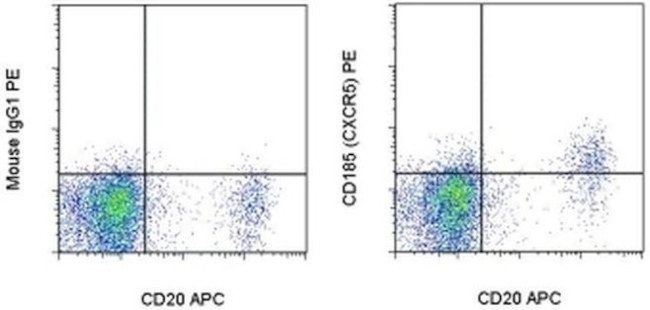
FIGURE: 1 / 1
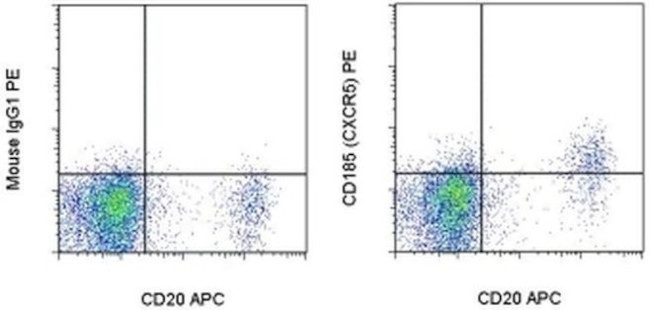
CD185 (CXCR5) Antibody (12-1859-41) in Flow
Staining of normal rhesus peripheral blood cells with Anti-Human CD20 APC (Product # 17-0209-42) and Mouse IgG1 K Isotype Control PE (Product # 12-4714-81) (left) or Anti-Non-Human Primate CD185 (CXCR5) PE (right). Cells in the lymphocyte gate were used for analysis.

Product Details
12-1859-41
Applications
Tested Dilution
Publications
Product Specifications
Species Reactivity
Non-human primate,
Rhesus monkey
Published species
Cynomolgus monkey
Host/Isotype
Mouse
/ IgG1, kappa
Recommended Isotype Control
Class
Monoclonal
Type
Antibody
Clone
87.1
Conjugate
PE
Excitation/Emission Max
565/576 nm
View spectra

Form
Liquid
Concentration
5 µL/Test
Purification
Affinity chromatography
Storage buffer
PBS, pH 7.2, with 0.2% BSA
Contains
0.09% sodium azide
Storage conditions
4° C, store in dark, DO NOT FREEZE!
Shipping conditions
Wet ice
RRID
AB_11219676
Product Specific Information
Description: This 87.1 monoclonal antibody reacts with non-human primate (specifically rhesus) CD185. CD185, which is also known as C-X-C chemokine receptor 5 (CXCR5) and Burkitt lymphoma receptor 1 (BLR1), is a seven transmembrane G protein-coupled receptor originally identified in Burkitt's lymphoma. In peripheral blood, CD185 is expressed on B cells, CD4+ T cells (but not Th1 or Th2 cells), and a subpopulation of memory (CD45RO+) T cells. CD185+ circulating T cells are in a resting state and migrate to the lymph nodes due to CCR7 and CD62L expression. In tonsils, CD185 is expressed on nearly all CD4+ cells along with CD45RO and the activation markers CD69 and ICOS. Tonsillar CD185+ cells have been shown to induce antibody production when co-cultured with B cells, thus supporting their role in providing B cell help. Furthermore, this chemokine receptor plays a critical role in lymphocyte trafficking, in particular CXCL13-induced T cell migration into the B cell follicles of germinal centers. Thus, CD185 is an established marker of follicular helper T cells (Tfh). In rhesus macaques, infection with simian immunodeficiency virus (SIV) has been reported to increase the number of germinal centers and Tfh cells within the lymph nodes.
Refer to the rhesus reactive alternative clone MU5UBEE (cat. 12-9185) for identification of CXCR5 on T cells in addition to B cells.
Applications Reported: This 87.1 antibody has been reported for use in flow cytometric analysis.
Applications Tested: This 87.1 antibody has been pre-titrated and tested by flow cytometric analysis of normal rhesus peripheral blood cells. This can be used at 5 µL (0.125 µg) per test. A test is defined as the amount (µg) of antibody that will stain a cell sample in a final volume of 100 µL. Cell number should be determined empirically but can range from 10^5 to 10^8 cells/test.
Excitation: 488-561 nm; Emission: 578 nm; Laser: Blue Laser, Green Laser, Yellow-Green Laser.
Filtration: 0.2 µm post-manufacturing filtered.
Target Information
CXCR5 (C-X-Chemokine Receptor Type 5, CD185) also known as Burkitt lymphoma receptor 1 (BLR1) belongs to the CXC chemokine receptor family. CXCR5 is a G protein-coupled seven transmembrane receptor for chemokine BLC. CXCR5 gene is specifically expressed in Burkitt's lymphoma and lymphatic tissues, such as follicles in lymph nodes, as well as in spleen. Studies of CXCR5 suggest that it plays an essential role in B cell migration. CXCR5 expression has been reported in human blood and salivary gland and in animal lymphatic organs, blood, bone marrow, brain, liver, lymph node, skin, spleen, stomach, and tonsil. ESTs (expressed sequence tags) have been isolated from human brain, germ cell, lung, lymph, and pancreas. G-protein Coupled Receptors (GPCRs) comprise one of the largest families of signaling molecules with more than a thousand members currently predicted to exist. All GPCRs share a structural motif consisting of seven membrane-spanning helices, and exist in both active and inactive forms. An array of activating ligands participate in the conformation of GPCRs which leads to signaling via G-proteins and downstream effectors. Research studies have also shown the vast series of reactions which participate in the negative regulation of GPCRs. This "turn-off" activity in GPCRs have tremendous implications for the physiological action of the cell, and continues to drive pharmacological research for new drug candidates. Two blockbuster drugs which have been developed as GPCR-targeted pharmaceuticals are Zyprexa (Eli Lilly) and Claritin (Schering-Plough) which are used in mental health and allergy applications, respectively.
For Research Use Only. Not for use in diagnostic procedures. Not for resale without express authorization.
Bioinformatics
Protein Aliases: Blr-1; Burkitt lymphoma receptor 1; C Cmotif chemokine; C X C motif chemokine; CC motif chemokine; CCmotif chemokine; CD185 antigen; CXC; CXC motif chemokine; GPR9; HUMSTR
Gene Aliases: BLR1; EGK_06966
Entrez Gene ID: (Rhesus monkey) 701792

Performance Guarantee
If an Invitrogen™ antibody doesn't perform as described on our website or datasheet,we'll replace the product at no cost to you, or provide you with a credit for a future purchase.*
Learn more
We're here to help
Get expert recommendations for common problems or connect directly with an on staff expert for technical assistance related to applications, equipment and general product use.
Contact tech support